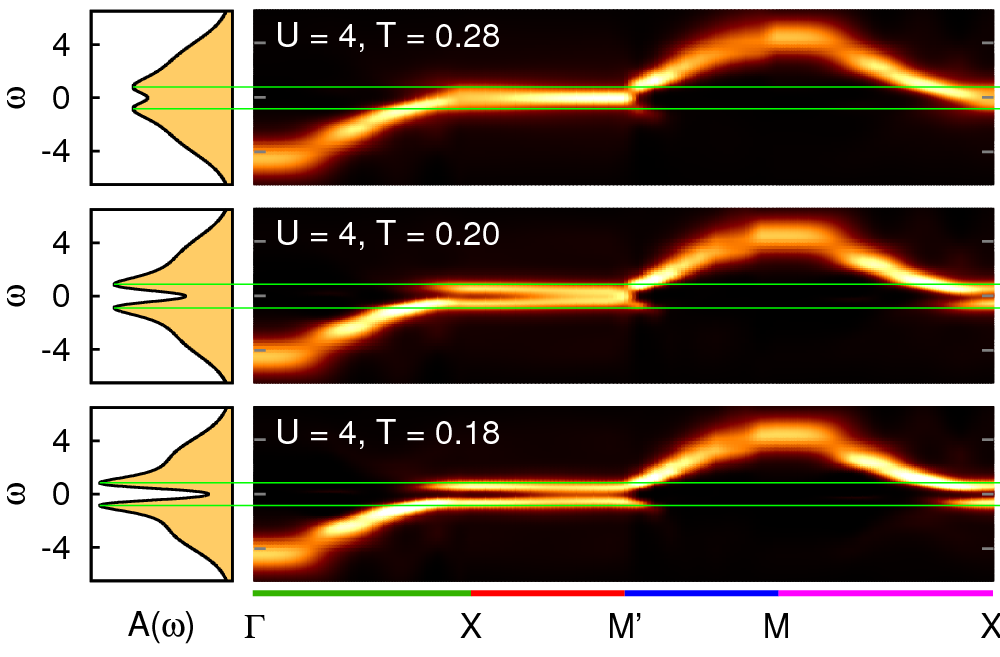
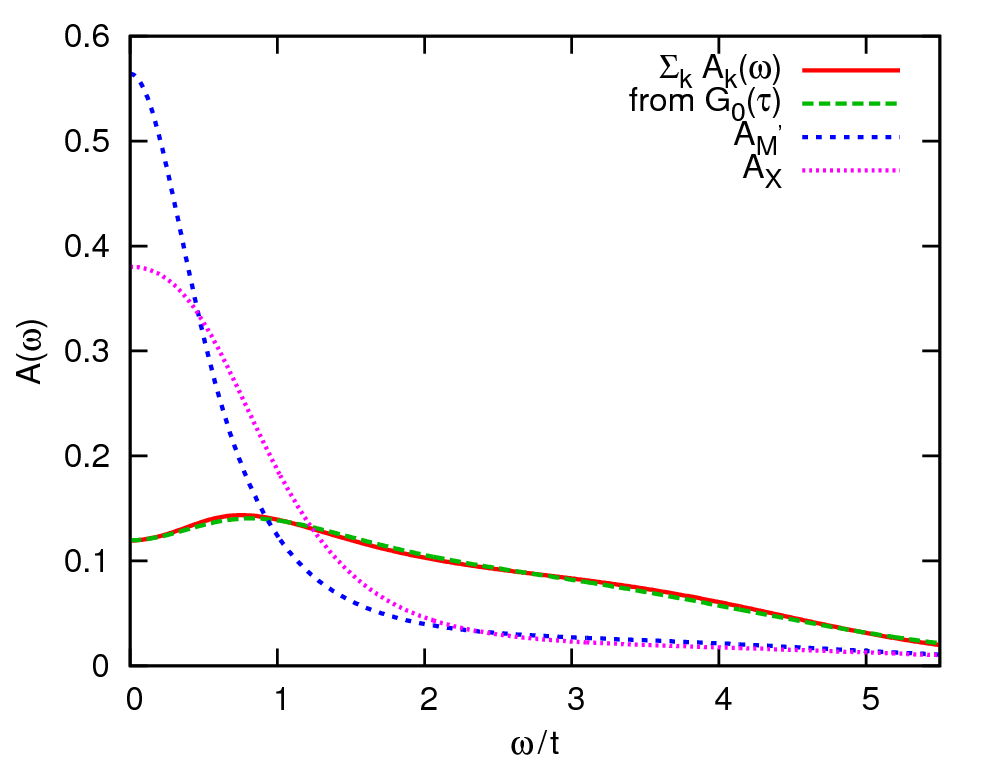
while working on the paper, I performed some further analysis on Fig 1c. The added light green horizontal lines (first attached figure) correspond exactly to the frequencies 0.82 <= omega <= 0.89 , where the local spectra have maxima. At the highest temperature T=0.28, we see a pseudogap-like dip in the local spectrum while the nodal and antinodal spectra both have quasiparticle-like shape (2nd attached figure). Due to the check local versus k-integration it looks like this feature is real.
Apparently, the finite-frequency maxima at T=0.28 are associated with the high weight of the arc-like portions of the dispersion about 20% away from the X or M' points, respectively. Do we understand this?
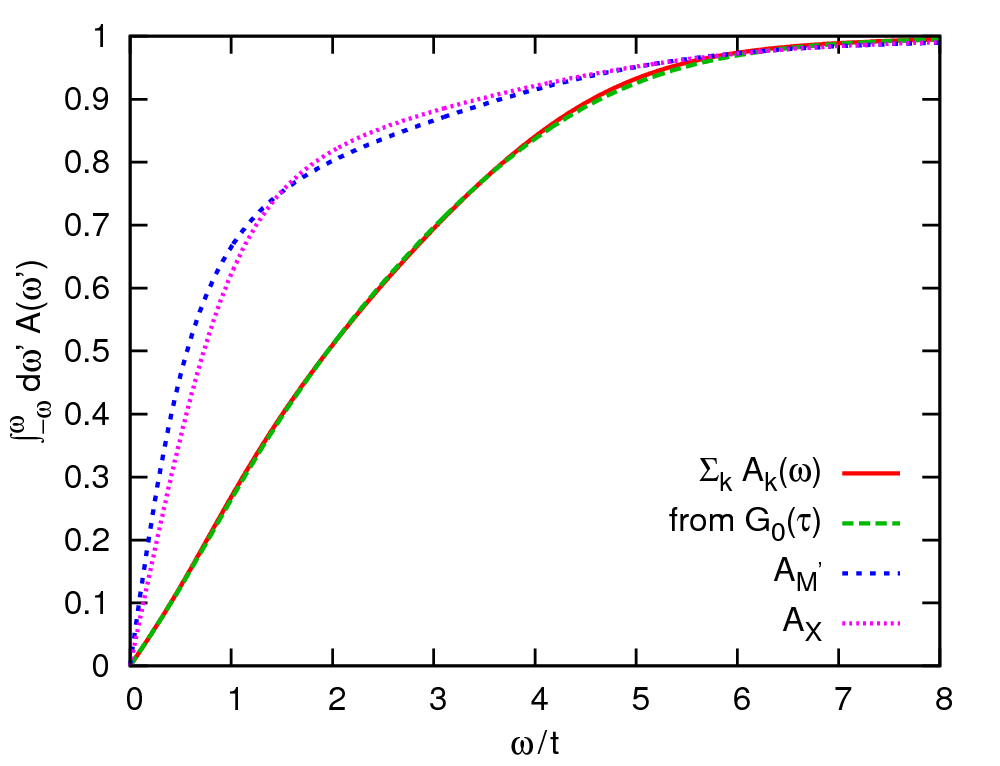
Could one interpret this behavior as a kind of pre-pseudogap where the low-frequency weight along the Fermi edge is first suppressed more or less uniformly as a function of frequency before it it splits at X and later at M'? Then why is the weight in the arcs less suppressed? In order to compare the contribution of spectral weight, I have just created a plot of integrated weight (3rd attached figure).
Bests, Nils
PS: Fakher, thank's for the new abstract and intro. More about this soon.
	Nils Blümer
	Institut für Physik, KOMET 337                  Room: 03 134, Staudingerweg 7
	Johannes Gutenberg-Universität          Phone: (+49) 6131 / 392 22 77
	55099 Mainz, Germany                            FAX:   (+49) 6131 / 392 09 54
	http://komet337.physik.uni-mainz.de/Bluemer/